PresentNarva Hermanni linnus
A fortress on the riverbank founded by the Danes in the 13th century and rebuilt many times since. The Hermann tower is the best-known part of the city's silhouette.
Why it belongs to the storyFrom the castle wall you see two states at once. Danes, the Livonian Order, Swedes, tsarist power, the Soviet Union and the Republic of Estonia have all been here — not one history but layers.
- Visit time
- 90 min
- Season
- Any season
- Access
- Partly accessible, tower by stairs only
Border & heritageArchitectureCulture & many languages
PresentNarva jõe promenaad
A riverside promenade completed in 2019, directly opposite Ivangorod fortress.
Why it belongs to the storyThe most direct place to understand what the EU's external border means in daily urban life: people walk and fish here while another state lives on the far bank.
- Visit time
- 40 min
- Season
- Any season
- Access
- Accessible, ramped
Border & heritageWater & coast
PresentNarva raekoda ja Rootsi lõvi
A 17th-century baroque town hall — one of the few buildings that survived the destruction of 1944. The Swedish Lion monument stands nearby.
Why it belongs to the storyThe town hall stands alone where a baroque old town used to be. The emptiness around it is as much information as the building itself.
- Visit time
- 30 min
- Season
- Any season
- Access
- Outdoor space accessible
Architecture
PresentKreenholmi manufaktuur
A textile mill founded in 1857 on a river island, once among the largest in the world. A red-brick town of its own between the rapids.
Why it belongs to the storyKreenholm explains why the region is what it is: industry brought people, people brought languages, and the industry's departure left buildings and the question of what to do with them.
- Visit time
- 120 min
- Season
- Any season
- Access
- Guided visits only, parts closed
Industry & reuseArchitectureWater & coast
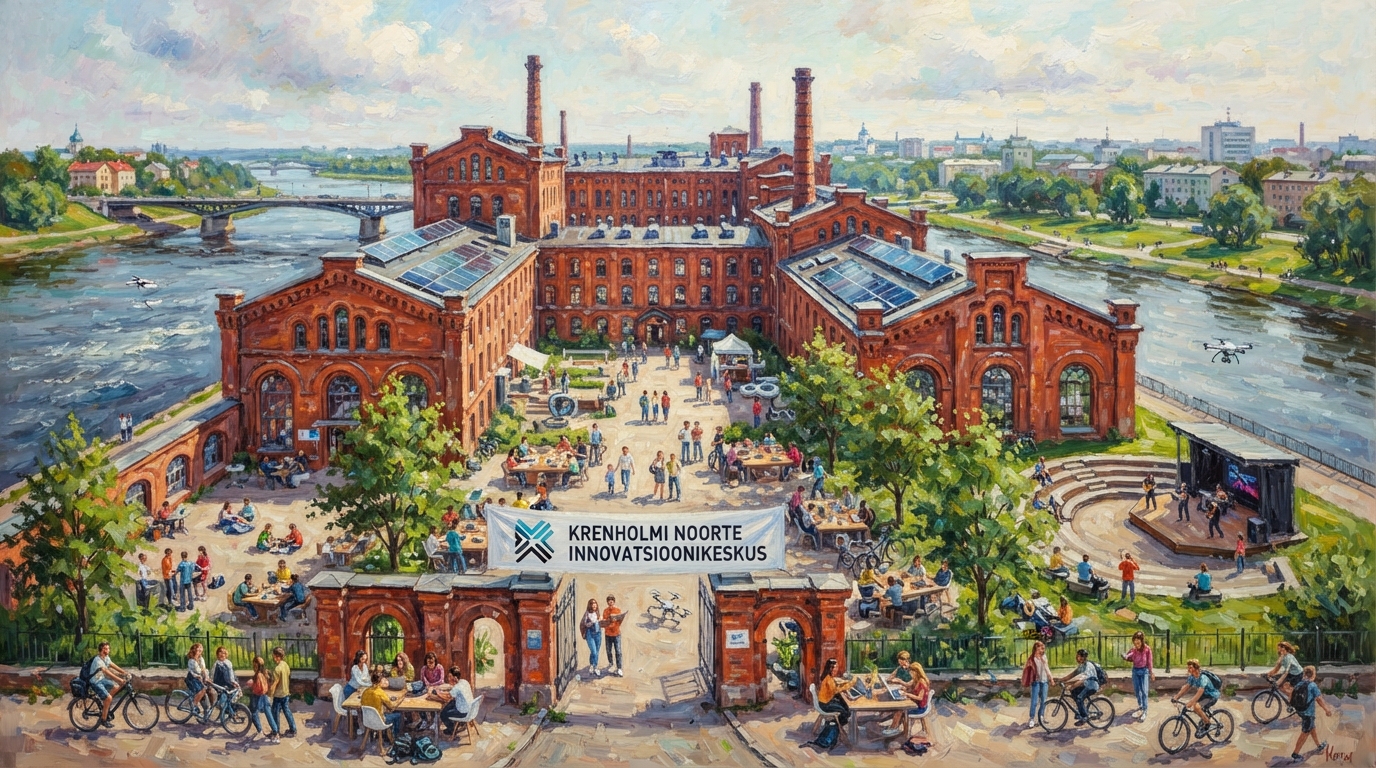
VisionKreenholmi noorte innovatsioonikeskus
An imagined scenario: workshops, studios and youth-run companies move into the Kreenholm brick halls, with cafés and an open-air stage in the yard.
Why it belongs to the storyThis vision is deliberately larger than today's situation. It shows what would happen if the existing industrial heritage were reused instead of demolished.
- Visit time
- 60 min
- Season
- Any season
- Access
- Vision — does not exist yet
Youth & futureIndustry & reuseCulture & many languages
PresentNarva noortekeskus
The city youth centre, hosting concerts, workshops and language cafés. Activity runs in both Russian and Estonian.
Why it belongs to the storyIf you want to know where the region is heading, you hear it here before it reaches the statistics.
- Visit time
- 45 min
- Season
- Any season
- Access
- Accessible
Youth & futureCulture & many languages
VisionNarva jõeäär 2050
An artist's image of the riverfront with saunas, boat traffic, canoe rental and a peaceful crowd — between two fortresses.
Why it belongs to the storyThis is not today's Narva. It is a considered scenario showing what the river could be if it were not only a border.
- Visit time
- 20 min
- Season
- Summer
- Access
- Vision — an artist's scenario
Water & coastYouth & futureCulture & many languages
MemoryNarva jõe lüüsid
An artist's reconstruction of a time when ships moved on the river and passengers walked the embankment. Falls and dams later changed how the water moves.
Why it belongs to the storyA memory layer: the river was a transport route before it was a border. Without that, you cannot understand why a city appeared here at all.
- Visit time
- 25 min
- Season
- Any season
- Access
- Historical material and a viewpoint
Water & coastIndustry & reuse
PresentNarva hüdroelektrijaam
A station completed in 1955 whose reservoir extends across the border. The dam changed the volume of water in the Narva falls.
Why it belongs to the storyAn example of energy production rewriting the landscape — the falls are now mostly dry and are opened only occasionally.
- Visit time
- 40 min
- Season
- Any season
- Access
- External viewpoint, industrial site closed
Industry & reuseWater & coast